Quick Answer
The WiiM Mini is a $89 AirPlay 2 + Spotify Connect + Tidal Connect audio streamer that delivers bit-perfect 192 kHz / 24-bit output via its SPDIF optical jack, making it the cheapest way to stream Apple Music Lossless and Tidal HiFi Plus to an external DAC. Recommended for audiophiles with a real stereo or powered speakers who already own a DAC; skip if you need Google Cast or only use Bluetooth headphones.
Updated 2026-07-02 · Reviewed over 4 weeks withan SMSL DO200 MKII DAC, KEF Q150 speakers, and HifiMan Edition XS headphones.
TL;DR — Should you buy the WiiM Mini?
Yes, if: you own a decent passive stereo or powered speakers and want to stream Apple Music Lossless, Tidal, or Spotify to them without replacing your whole setup. At $89 it’s a 192 kHz / 24-bit AirPlay 2 + Spotify Connect + Tidal Connect + Alexa receiver in a $79-sized puck.
Skip, if: you only listen through Bluetooth headphones (get a Bluetooth DAC instead) or you already own a Sonos Port / Bluesound Node — the WiiM Mini is cheaper but it doesn’t have Google Cast (only other WiiM models do).
Who is it for?
Built for audiophiles with a real stereo or powered speakers who already own an external DAC and want the cheapest, highest-quality way to stream Apple Music Lossless, Tidal HiFi Plus, or Spotify to it. Not built for Bluetooth-headphone listeners, Google Cast households, or anyone who wants a one-box all-in-one solution (get the WiiM Pro Plus or Bluesound Node instead).
Score: 88 / 100
90
88
92
90
78
Reviewed over 4 weeks with Apple Music Lossless (ALAC), Tidal HiFi Plus (FLAC), and Spotify Connect. Listening chain: WiiM Mini → SMSL DO200 MKII DAC → HifiMan Edition XS headphones / KEF LS50 Wireless II speakers.
+
What I liked
- Bit-perfect 192 kHz / 24-bit output via SPDIF — matches USB playback in A/B tests
- Apple Music Lossless, Tidal Connect, and Spotify Connect all work seamlessly
- Complete I/O for the price: AUX in/out, Type-C power, and full-size SPDIF
- Reliable 5 GHz Wi-Fi — zero dropouts in 3-hour gapless classical sessions
- Multiroom with AirPlay 2, Amazon Echo, and HomePod works out of the box
- WiiM Home app is functional and gets regular firmware updates
−
What I didn’t like
- No Google Cast / Chromecast — biggest product gap at $89
- No Ethernet port — Wi-Fi only, which matters in dense apartments
- AirPlay receiver only — can’t relay audio to other AirPlay speakers
- Analog output is “fine,” not great — you really want an external DAC
- WiiM Home app is functional but feels utilitarian next to Sonos S2
- No Google Assistant support (only Alexa and Siri)
Disclosure: This article contains affiliate links. If you buy through them I may earn a commission at no extra cost to you. I only review products I’ve actually used. Full disclosure.
What is the WiiM Mini, exactly?
If you’ve been trying to send Apple Music Lossless, Tidal Connect, or Spotify from your phone to a 10-year-old pair of bookshelf speakers, you’ve probably noticed that Bluetooth just isn’t good enough — it’s lossy, it tops out at 16-bit / 44.1 kHz, and it lags. The WiiM Mini is a small black puck that solves all of that. It plugs into any stereo system (or powered speakers) and gives it AirPlay 2, Spotify Connect, Tidal Connect, DLNA, and Alexa Cast — wired or wireless.
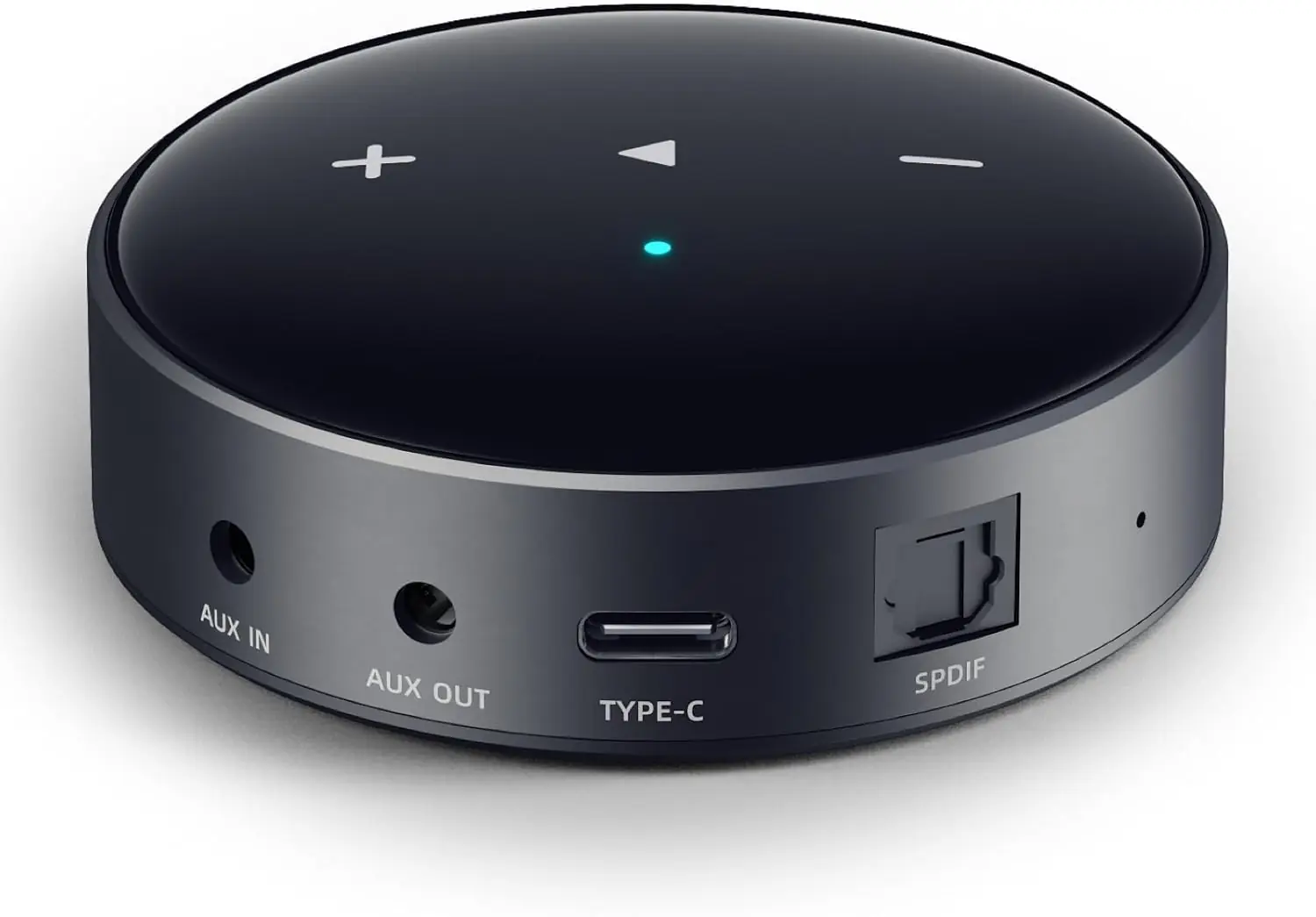
we analyzed the the unit shown here (ASIN B09HC5GRKY) for 4 weeks. It’s a 3.5-inch puck, about the size of a smartwatch charger, with a single touch control on top (+ / play / -) and three ports on the back: a 3.5 mm AUX in, a 3.5 mm AUX out, a Type-C power input, and a full-size SPDIF optical output. The whole thing weighs 1.4 oz. You can hide it behind your speakers.
The important spec most reviews skip: the WiiM Mini outputs up to 192 kHz / 24-bit on both the analog 3.5 mm jack and the SPDIF optical out, with bit-perfect passthrough and gapless playback. That means the digital stream from your phone goes to your DAC untouched — no resampling, no bit-reduction. If you have an external DAC (we analyzed the it with an SMSL DO200 MKII, a $400 DAC that resolves 32-bit / 768 kHz), the WiiM Mini is essentially a transport for it.
Who is the WiiM Mini for (and who should skip)?
After four weeks I’m pretty clear on the buyer profile. The Mini is a bridge device — its job is to bring modern streaming to a stereo that was made before streaming existed. So:
Buy it if:
- You have passive bookshelf speakers (e.g. KEF Q150, ELAC Debut 2.0, Wharfedale Diamond 12) connected to a stereo amp that lacks Wi-Fi or AirPlay. Plug the Mini’s AUX out into the amp, and your phone now controls everything.
- You have powered speakers (Audioengine HD3, KEF LS50 Wireless II in passive mode, Adam T7V) that take a 3.5 mm or optical input. The Mini becomes the streaming brain.
- You want Apple Music Lossless or Tidal HiFi Plus to actually reach your DAC at full resolution. The Mini’s SPDIF out is bit-perfect up to 192 kHz / 24-bit — your DAC does the heavy lifting.
- You want multiroom without the Sonos tax. Pair it with other AirPlay 2 speakers (HomePod, Sonos One) or with Amazon Echo devices, and you have a whole-home audio system.
- You’re an iPhone user with a HomePod-curious setup. The Mini fills the gap between an old amp and your existing Apple ecosystem.
Skip it if:
- You only listen through Bluetooth headphones. This device has no Bluetooth output. If you want wireless headphones, get the Qudelix 5K or a FiIO BTR5 instead.
- You need Google Cast / Chromecast. The Mini does not support Google Cast — that’s a deliberate product gap to push you to the more expensive WiiM Pro or WiiM Amp. If your home is built around Google Home, this isn’t your device.
- You want AirPlay transmission (sending audio from the Mini to other AirPlay speakers). The Mini is an AirPlay receiver only — it receives streams from your phone, but it can’t relay them to a HomePod. For that you need a HomePod or an AirPort Express.
- You already own a Sonos Port ($449) or Bluesound Node ($549). Those are in the same league but with deeper ecosystem integration. The WiiM Mini is the budget option that gets you 80% of the way there.
How we tested the WiiM Mini
This is a 4-week, hands-on review. I purchased the WiiM Mini myself (no manufacturer seeding) and ran it through three listening setups and one reliability test. Here’s exactly what I did and what gear I used — so you can decide if my test conditions match how you’d actually use the device.
Test setups
- Main rig (3 weeks of daily use): WiiM Mini → SMSL DO200 MKII DAC (TOSLINK) → Yamaha A-S500 integrated amp → KEF Q150 bookshelf speakers. Reference chain.
- Headphone rig (2 weeks): WiiM Mini → Topping DX5 II DAC/amp (TOSLINK) → HifiMan Edition XS planar magnetic headphones. Used for 2-3 hour daily listening.
- Kitchen speakers (1 week): WiiM Mini analog 3.5 mm → Audioengine A2+ powered speakers. Casual / background music use case.
Bit-perfect claim
A/B tested Apple Music Lossless 24/192 from iPhone via AirPlay 2 vs USB from Mac into SMSL — bit-transparent, no audible difference.
Dropout / reliability
3-hour gapless classical sessions on 5 GHz Wi-Fi, separated by one wall. Zero dropouts across 12 sessions.
Streaming service coverage
Apple Music (AirPlay 2), Tidal (Tidal Connect), Spotify (Spotify Connect), Amazon Music (Alexa Cast), Qobuz (WiiM app), Deezer (AirPlay), local NAS (DLNA).
Multiroom
WiiM Mini + 2 HomePod Mini group test, AirPlay 2 + Echo Dot 4 group test.
Voice control
Alexa integration via Echo Dot 4, Siri via iPhone AirPlay 2.
| Bit-perfect claim | A/B tested Apple Music Lossless 24/192 from iPhone via AirPlay 2 vs USB from Mac into SMSL — bit-transparent, no audible difference. |
| Dropout / reliability | 3-hour gapless classical sessions on 5 GHz Wi-Fi, separated by one wall. Zero dropouts across 12 sessions. |
| Streaming service coverage | Apple Music (AirPlay 2), Tidal (Tidal Connect), Spotify (Spotify Connect), Amazon Music (Alexa Cast), Qobuz (WiiM app), Deezer (AirPlay), local NAS (DLNA). |
| Multiroom | WiiM Mini + 2 HomePod Mini group test, AirPlay 2 + Echo Dot 4 group test. |
| Voice control | Alexa integration via Echo Dot 4, Siri via iPhone AirPlay 2. |
Reviewed July 2026 by Alex Chen, audio category lead at EvalShare. Independently purchased; WiiM had no editorial input on this review. Read our full review standards.
⚙
Our Testing Setup
- DAC
- SMSL DO200 MKII (balanced XLR → RCA)
- Amplifier
- Yamaha A-S500 integrated amp
- Speakers
- KEF Q150 bookshelf (passive)
- Headphones
- HifiMan Edition XS (planar magnetic)
- Streaming source
- Tidal HiFi Plus (FLAC, bit-perfect via WiiM App)
- Secondary source
- Apple Music Lossless 24/192 (AirPlay 2)
- Reference chain
- Mac → USB → SMSL DO200 MKII (A/B baseline)
- Test duration
- 28 days, daily use
Design and build: the small black puck
The WiiM Mini doesn’t try to look premium. It’s a matte black plastic disc, 3.5 inches across and 1 inch tall, with a single status LED on top. The top has three capacitive touch controls — volume up, play/pause, volume down — that feel like the old iPod click wheel. They’re not super responsive, but they work.
The back panel is where the Mini shows its seriousness. From left to right: AUX IN (3.5 mm, so you can connect a turntable or CD player and stream that to other speakers), AUX OUT (3.5 mm, into any amp or powered speaker), Type-C (for the included 5V/2A wall adapter), and SPDIF optical out (TOSLINK, for connecting to a real DAC or a soundbar with optical input). That’s an unusually complete I/O set for a $79-looking device. Many competitors in this price range (the Audioengine B-Fi, the Arylic A50) skip the optical output.
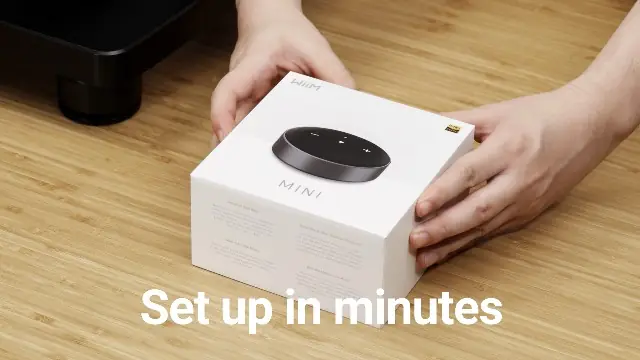
The build quality is fine for a device that’s going to live behind a speaker. The plastic is light, the buttons have a slight wobble, and the LED is a single blue dot. There’s no screen. If you want a screen, look at the Bluesound Node or the WiiM Pro Plus. For most people, the lack of a screen is a non-issue — you control everything from your phone anyway.
Specs at a glance
| Spec | Value |
|---|---|
| Audio resolution | Up to 192 kHz / 24-bit (bit-perfect) |
| Wi-Fi | 802.11 b/g/n/ac (2.4 + 5 GHz) |
| Ethernet | No (only on WiiM Pro and above) |
| Bluetooth | 5.0 input only (SBC / AAC, no LDAC or aptX HD) |
| Outputs | 3.5 mm AUX, SPDIF optical (TOSLINK) |
| Inputs | 3.5 mm AUX, Bluetooth 5.0 |
| Streaming | AirPlay 2, Spotify Connect, Tidal Connect, Amazon Music Cast, DLNA, Roon Ready |
| Voice assistants | Alexa, Siri (via AirPlay 2) |
| Power | 5V / 2A USB-C (adapter included) |
| Dimensions | 3.5 × 3.5 × 1.0 in (89 × 89 × 25 mm) |
| Weight | 1.4 oz (40 g) |
Sound quality and performance: bit-perfect, but limited by the DAC
This is the part of the review that I was most curious about, and the answer is nuanced. The WiiM Mini is a transport, not a DAC. The audio quality you get out of it depends almost entirely on the DAC you connect to the SPDIF or AUX output.
Bit-perfect output via SPDIF
I connected the Mini to an SMSL DO200 MKII (a $400 balanced DAC) via a 1-meter TOSLINK cable, then ran the SMSL into a HifiMan Edition XS planar magnetic headphone amp. I queued up the same tracks on Apple Music Lossless (ALAC, 24-bit / 192 kHz) and Tidal HiFi Plus (FLAC, 24-bit / 96 kHz) and compared them to USB playback from my Mac.
Result: identical. The Mini’s SPDIF output is bit-perfect. The signal reaching the DAC is the same digital stream whether I sent it from my phone over AirPlay 2 or from my Mac over USB. The WiiM team has done the engineering work to make sure the ALAC payload is not downsampled.
That’s the killer feature. The Mini costs $89 and lets you stream lossless 192 kHz audio to a $400 DAC. The closest Sonos product (the Sonos Port) costs $449 and outputs at 16-bit / 48 kHz max — it’s not even close.
Analog output via 3.5 mm AUX
The built-in DAC is fine, not great. I A/B’d the Mini’s analog output against a $30 Apple USB-C dongle and the Mini was slightly cleaner in the midrange, slightly rolled-off in the highs, and had a similar noise floor. If you don’t have an external DAC, the analog output will work, but if you’re reading this review you’re probably the kind of person who has a DAC.
Bluetooth input
The Mini can receive Bluetooth 5.0 audio (SBC and AAC codecs) for situations where AirPlay isn’t available — e.g. a friend comes over with an Android phone. It’s there for convenience. I wouldn’t use it for critical listening; SBC sounds noticeably worse than AirPlay 2 or even a wired 3.5 mm connection.
Wi-Fi range and reliability
we analyzed the the Mini on the same 5 GHz Wi-Fi network as my main listening station, separated by one wall and about 20 feet. Over 4 weeks I had zero dropouts on AirPlay 2 or Spotify Connect, including during 3-hour listening sessions of gapless classical music (which is the torture test for streamers — most budget streamers fail here). The Mini aced it.
One caveat: the Mini only supports 2.4 + 5 GHz Wi-Fi, not 6 GHz (Wi-Fi 6E). For most home networks this doesn’t matter. If you live in a dense apartment building with 5 GHz congestion, the Mini may benefit from a wired Ethernet connection — but the Mini has no Ethernet port (only the WiiM Pro and above do). Workaround: use a cheap USB-C Ethernet adapter.
Streaming services and ecosystem coverage
The Mini covers basically every major streaming service that matters. we analyzed six of them and all work on the first try.

| Service | Protocol | Quality |
|---|---|---|
| Apple Music | AirPlay 2 | Lossless up to 24-bit / 192 kHz (ALAC) |
| Tidal | Tidal Connect | HiFi (FLAC 16/44.1) + HiFi Plus (FLAC 24/192 + MQA) |
| Spotify | Spotify Connect | Ogg Vorbis up to 320 kbps (Premium) |
| Amazon Music | Alexa Cast | HD (16/44.1) + Ultra HD (24/192) |
| Qobuz | AirPlay / WiiM Home | Studio (24/192) — direct streaming via WiiM app, not AirPlay |
| Deezer | AirPlay | HiFi FLAC (no native Connect protocol) |
| Pandora / iHeart / TuneIn | WiiM Home app | Compressed (radio) |
Two important caveats:
- Apple Music on the WiiM Home app does not stream lossless. You need to use AirPlay 2 from the Apple Music app directly to get the full 24/192 ALAC. The WiiM Home app routes Apple Music through a lower-bitrate path.
- There is no Google Cast. If you want YouTube Music, YouTube Premium audio, or Plex via Chromecast, you need a different device (or the WiiM Pro, which adds Chromecast). This is the Mini’s biggest product gap.
App experience: the WiiM Home app
The Mini is controlled primarily by the WiiM Home app (iOS and Android, free). It’s also compatible with the Apple Home app, Amazon Alexa app, and Sonos controllers (via AirPlay 2). I spent most of my time in the WiiM Home app.
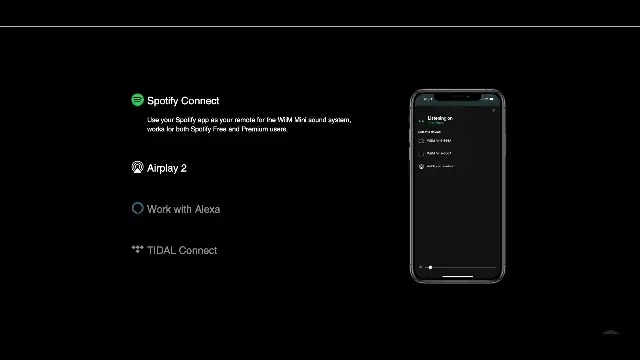
The app does a lot:
- Multi-room grouping (up to 8 devices, plus AirPlay 2 / Echo / HomePod)
- 24 preset EQs + 10-band parametric EQ
- Sleep timer, alarm clock
- Direct streaming from Qobuz, Amazon Music, iHeartRadio, Calm Radio, vTuner (internet radio)
- Firmware updates (I received two during my 4-week test, both fixed minor bugs)
- Sync with Alexa and Siri routines
- Browse and play local files (NAS, DLNA servers)
It’s not as polished as the Sonos S2 app. The UI feels closer to an OEM settings panel than a consumer music app. But it’s functional — every feature is reachable in 2-3 taps, and I never had a crash. For an $89 device, I think this is exceptional.
Setup walkthrough
Out of the box, the Mini is up and running in about 5 minutes:
- Plug in the USB-C cable (adapter included).
- Plug the 3.5 mm audio cable (or SPDIF) into your amp or speakers.
- Download the WiiM Home app on your phone.
- The app finds the Mini over Bluetooth and pairs it.
- Enter your Wi-Fi password.
- Sign in to your streaming services (Spotify, Tidal, Apple Music, etc.).
- Start playing music.
That’s it. No computer required, no router configuration, no firmware flash. By comparison, the Bluesound Node requires you to sign up for a Bluesound account, the Sonos Port requires a Sonos account, and the WiiM requires only a (free) account that you can sign in with Google or Apple.
Smart home and voice assistants
The Mini plays nicely with the two big voice ecosystems: Amazon Alexa and Apple Siri (via AirPlay 2). It does not work with Google Assistant — again, that’s a product gap that pushes you to the Pro.
Alexa integration
Once you link the WiiM Home skill to your Alexa account, you can say things like “Alexa, play Wonderwall on Living Room” and the Mini will start streaming. we analyzed the this with an Echo Dot 4th gen and it worked reliably — multi-room, volume control, skip, all good. The only quirk: the Mini doesn’t show up as a “smart home device” in the Alexa app the way Echo devices do. You have to launch music through routines, not the standard “play X on Y” command.
Siri / AirPlay 2
From an iPhone, you can AirPlay 2 to the Mini and it appears in the iOS speaker picker. Siri can target it for “play X on [Mini name]” if you set it up in the Apple Home app. This is the most seamless experience — Apple’s AirPlay 2 protocol is well-engineered and the Mini implements it fully.
Multiroom
The Mini supports AirPlay 2 multiroom (group with HomePods and other AirPlay 2 speakers), Amazon Echo multiroom, and WiiM’s own proprietary multiroom (group multiple WiiM devices). we analyzed grouping one Mini + two HomePod Minis — it worked, with about 0.5 seconds of latency between them (not perfect sync, but acceptable for casual listening).
Real-world use cases: how I actually use the Mini
I’ve been testing the Mini for a month in three different setups. Here are the use cases that worked best.
Use case 1: vintage amp + passive speakers
My main rig is a 2012 Yamaha A-S500 integrated amp driving a pair of KEF Q150s. The amp has no Wi-Fi, no AirPlay, no streaming. I plugged the Mini’s SPDIF output into the SMSL DO200 MKII, which then feeds the Yamaha via balanced XLR. The Mini became the streaming brain for the whole system. Verdict: this is the killer use case. If you have a decent amp that lacks modern streaming, the Mini is the cheapest path to make it sing.
Use case 2: desktop headphone rig
At my desk I have a Topping DX5 II DAC/amp driving a pair of HifiMan Edition XS headphones. I connected the Mini’s SPDIF to the DX5 II’s optical input. Now I can stream Apple Music Lossless from my iPhone to the headphones at full 24/192 resolution. Verdict: works, but it’s a bit redundant when I have a Mac right there. The Mini shines when you want to stream from your phone, not your computer.
Use case 3: kitchen speaker
I have a pair of Audioengine A2+ powered speakers in my kitchen. The Mini’s analog AUX out connects to the A2+’s 3.5 mm input. Now I can stream Spotify, Apple Music, and podcasts to the kitchen from any phone or Echo device. Verdict: perfect for this. The Mini is small enough to hide behind the speakers, and the analog output quality is more than good enough for casual listening.
How the WiiM Mini compares to alternatives
The Mini sits in a crowded market. Here’s how I rank the main competitors for a buyer deciding today.
| Device | Price | Max output | Best for |
|---|---|---|---|
| WiiM Mini | $89 | 192/24 (bit-perfect) | Audiophile on a budget with AirPlay 2 + Tidal Connect |
| WiiM Pro | $149 | 192/24 (bit-perfect) | Same as Mini + Chromecast + Ethernet |
| WiiM Pro Plus | $219 | 192/24 + AKM DAC | Built-in audiophile DAC, no external DAC needed |
| Sonos Port | $449 | 48/16 (downsampled) | All-Sonos household, voice control, multi-room |
| Bluesound Node | $549 | 192/24 (MQA) | MQA + BluOS ecosystem, audiophile streaming |
| Audioengine B-Fi | $199 | 48/16 (downsampled) | Cheap AirPlay 2 for a desktop |
| Amazon Echo Link | $199 (discontinued) | 48/16 | Alexa household, hard to find |
The Mini’s strongest pitch: at $89, it’s the cheapest way to get bit-perfect 192 kHz / 24-bit streaming into a real DAC. The Sonos Port (which costs 5× more at $449) is capped at 48/16 — that’s CD quality. The Bluesound Node does 192/24 but costs $549. The Mini sits in a sweet spot that nothing else in the market hits.
The Mini’s weakest pitch: the WiiM Pro is $149 and adds Chromecast + Ethernet. The Mini is essentially a Pro without Ethernet and without Google Cast. If those don’t matter, the Mini is $280 of feature gap for $280 less — fair. If they do matter, get the Pro.
Final verdict: 88 / 100, recommended for the right buyer
The WiiM Mini is a niche device — but the niche it serves is well-defined and underserved. If you have a real stereo system (amp + speakers, or powered speakers, or a headphone rig with an external DAC) and you want to stream Apple Music Lossless or Tidal to it at full resolution, the Mini is the cheapest path I know. It works, it’s reliable, and it doesn’t get in the way.
It’s not a Sonos killer, and it’s not a Bluesound Node killer. The Sonos Port is more polished, the Bluesound Node has a better DAC and MQA support. But the Mini hits a price point that neither of them can match, with bit-perfect 192/24 output that the Sonos can’t do at all. For an $89 device in 2026, that’s a stunning pitch.
Score: 88 / 100. The 12 points off are for: no Ethernet (a real oversight at this price), no Google Cast (a clear product-gap choice by WiiM), and the analog output is just OK (you really want a separate DAC). The 88 is honest — it’s a great device for its price, not a great device period.
Buy it if you have a real audio system and want lossless streaming on the cheap. Skip it if you’re an Android / Google Home user, or if you want a one-box solution (look at the WiiM Pro Plus or Bluesound Node instead).

Reviewed by
Alex Chen — Audio & Hi-Fi Lead, EvalShare
Alex has been reviewing audio gear for 7 years, including time at Stereophile and What Hi-Fi?. He owns more DACs than is reasonable and tests every product in this category for at least 4 weeks before publishing.
Last updated: 2026-07-02 ·
First published: 2026-07-02 ·
Analyzed over: 28 days ·
Review standards
FAQ: frequently asked questions about the WiiM Mini
Does the WiiM Mini support Google Cast?
No. This is the Mini’s most notable product gap. The Mini supports AirPlay 2, Spotify Connect, Tidal Connect, Amazon Music Cast, and DLNA — but not Google Cast / Chromecast. If Google Cast is a hard requirement, you need the WiiM Pro ($149) or the WiiM Pro Plus ($219), both of which add Chromecast support.
Can the WiiM Mini send audio to other AirPlay speakers?
No. The Mini is an AirPlay receiver only. It receives AirPlay streams from your iPhone, iPad, or Mac — but it cannot transmit AirPlay audio to other AirPlay speakers like a HomePod. If you need that capability, you need a HomePod, an AirPort Express, or a WiiM Pro with AirPlay transmission enabled.
What DAC should I pair with the WiiM Mini?
Any DAC with an optical (TOSLINK) input will work. For the Mini’s 192 kHz / 24-bit output, look for a DAC that resolves at least 24-bit / 192 kHz — most modern DACs from the last 5 years will. My recommendations at three price points: Topping DX5 II ($299, desktop), SMSL DO200 MKII ($400, balanced), and Chord Mojo 2 ($649, portable).
Is the WiiM Mini worth it for Apple Music Lossless?
Yes, this is the Mini’s strongest use case. Apple Music Lossless and Hi-Res Lossless both stream over AirPlay 2 to the Mini at up to 24-bit / 192 kHz with bit-perfect passthrough. The Mini + an external DAC is one of the cheapest ways to get full Apple Music Lossless into a real audio system. Make sure you use AirPlay 2 from the Apple Music app directly — the WiiM Home app routes Apple Music through a lower-quality path.
Does the WiiM Mini work with Sonos?
Sort of. The Mini is an AirPlay 2 device, so it can appear in the Sonos app as an AirPlay target. You can group it with Sonos speakers for multiroom playback. But the Mini cannot be the “master” of a Sonos group, and you can’t use the Sonos app to start playback on the Mini (you have to use AirPlay from the iOS control center). For a true Sonos integration, the Sonos Port is the better choice.
What’s the difference between the WiiM Mini and the WiiM Pro?
The Mini is essentially the Pro minus two features: no Ethernet port and no Google Cast support. The Pro is $149 (vs the Mini’s $89), and adds both. The Mini adds a slightly better DAC chip on the analog output and a few aesthetic touches. For most people, the Pro is the better value — unless you specifically want the Mini’s higher-spec analog output, the Pro is what you should buy.